
TL;DR:
Modern cosmetic injectables are precise, natural-looking, and tailored to individual facial anatomy.
The main types include immediate fillers, biostimulators, and neuromodulators, each with distinct effects and durations.
Achieving natural results relies on skilled technique, conservative dosing, and thorough facial assessment by practitioners.
The idea that cosmetic injectables leave you looking frozen or unrecognisable belongs firmly in the past. Today’s treatments are precise, anatomy-driven, and designed to restore what time quietly takes away, not to alter who you are. Non-surgical treatments involve injecting carefully chosen substances to restore facial volume, smooth wrinkles, and refine contours, all without a scalpel in sight. Whether you are curious about your first treatment or simply want to understand your options better, this guide covers the science, the types, the techniques, and the safety considerations you need to make a genuinely informed decision.
Key Takeaways
| Point | Details |
|---|---|
| Modern approach | Today’s cosmetic injectables prioritise natural, subtle enhancements tailored to individual needs. |
| Types and duration | HA fillers provide instant results for 6–18 months; biostimulators offer gradual improvement lasting up to five years. |
| Safety matters | Expert injectors and careful planning significantly minimise risks and help avoid unnatural outcomes. |
| Care extends results | Routine aftercare and maintenance support long-lasting, satisfying results from cosmetic injectables. |
What are cosmetic injectables and how do they work?
Cosmetic injectables are non-surgical treatments delivered through fine needles or cannulas directly into targeted areas of the face or body. Their purpose is to address volume loss, smooth lines, and restore a rested, refreshed appearance. Unlike surgery, they require no general anaesthetic, no hospital stay, and typically very little recovery time, which is why so many people in Walthamstow and across the UK are choosing them as their preferred anti-ageing solution.
The science behind them is straightforward. Different injectable substances work through different mechanisms. Hyaluronic acid (HA) fillers attract and bind water molecules, instantly plumping and hydrating the treated area. Calcium hydroxylapatite (CaHA) and poly-L-lactic acid (PLLA) act as biostimulatory agents, triggering your skin’s own collagen production over time for a gradual, natural improvement. Polycaprolactone (PCL) works similarly, with results that can last several years.
Here is a quick overview of the main filler types and what to expect from each:
| Filler type | Main substance | Typical duration | Primary use |
|---|---|---|---|
| HA filler | Hyaluronic acid | 6 to 18 months | Lips, cheeks, under-eyes |
| CaHA filler | Calcium hydroxylapatite | 12 to 18 months | Jawline, cheeks, hands |
| PLLA filler | Poly-L-lactic acid | Up to 2 years | Full face volume, temples |
| PCL filler | Polycaprolactone | Up to 5 years | Skin laxity, deep volume |
Key benefits that make injectables so appealing include:
-
Minimal downtime: Most clients return to daily activities the same day
-
Reversibility: HA fillers can be dissolved if needed
-
Gradual or immediate results: Depending on the substance chosen
-
Highly customisable: Tailored to your anatomy and goals
The types of fillers available span a wide range of substances and durations, meaning your practitioner can match the right product to your specific concern. For those interested in combining injectables with other skin improvements, laser treatment benefits are worth exploring as a complementary approach to skin rejuvenation.
Types of cosmetic injectables: Fillers, biostimulators, and neuromodulators
Once you understand what injectables are, it helps to know the main types and how they deliver different results. The three broad categories are immediate fillers, biostimulators, and neuromodulators, and each has a distinct role in a well-planned treatment.
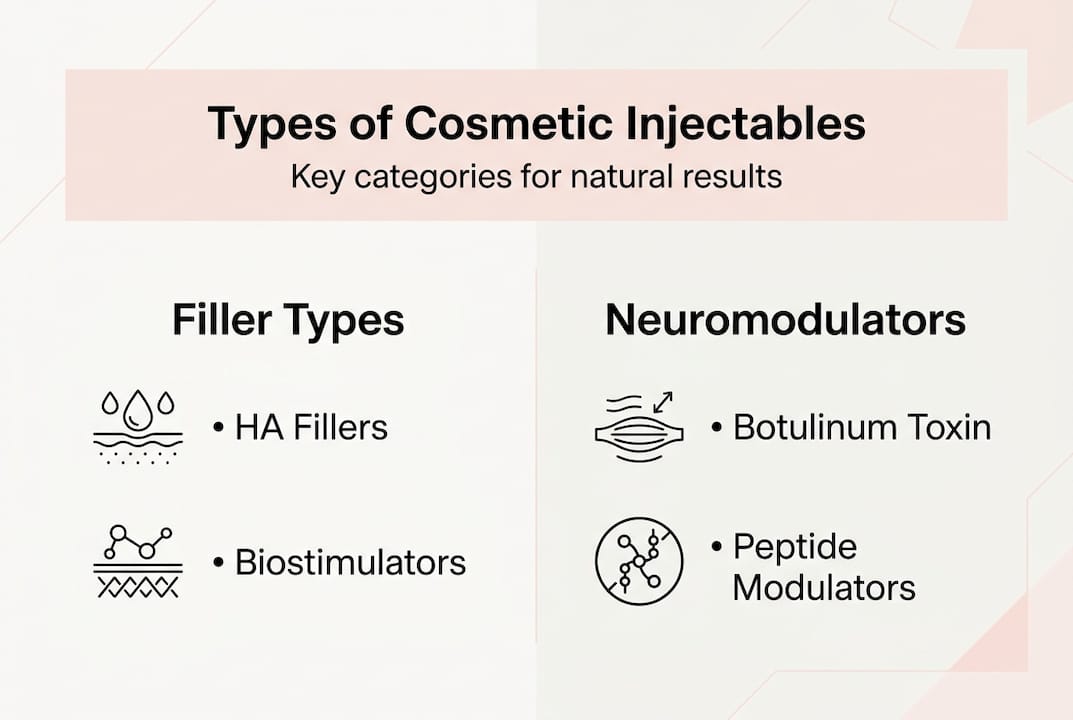
Immediate fillers, particularly HA-based products, give instant volume and are ideal for areas like the lips, cheeks, and nasolabial folds. You see the result the same day. Biostimulators such as PLLA and CaHA work differently, inducing a gradual collagen build-up over several weeks, so the improvement emerges naturally and looks entirely your own. Neuromodulators like botulinum toxin (commonly known by the brand name Botox) work by temporarily relaxing the muscles responsible for dynamic wrinkles, the lines that form when you smile, frown, or squint.
Here is a side-by-side comparison to help you understand the differences:
| Type | Substance | Onset | Reversible | Main uses |
|---|---|---|---|---|
| HA filler | Hyaluronic acid | Immediate | Yes, with hyaluronidase | Lips, cheeks, under-eyes |
| Biostimulator | CaHA, PLLA, PCL | Gradual (weeks) | No | Volume, skin laxity |
| Neuromodulator | Botulinum toxin | 3 to 7 days | No (wears off naturally) | Forehead, crow’s feet, frown lines |
A typical injectable treatment experience follows these steps:
-
Consultation: Your goals, medical history, and anatomy are assessed
-
Treatment planning: The practitioner maps out precise injection points
-
Preparation: Skin is cleansed and a topical numbing cream may be applied
-
Injection: Product is placed using a needle or blunt cannula
-
Review: Results are assessed and aftercare instructions are given
For a detailed walkthrough of what to expect, the dermal filler procedure guide offers practical, step-by-step insight.
Pro Tip: Combining a small amount of HA filler with a neuromodulator often produces the most balanced, natural result. Rather than using a large volume of one product, a layered approach addresses both volume loss and muscle movement for a genuinely refreshed look.
How are subtle, natural results achieved with cosmetic injectables?
Understanding the types is just the start; the real art lies in achieving a refreshed yet authentic look. The difference between a natural result and an overdone one almost always comes down to technique, product choice, and the practitioner’s knowledge of facial anatomy.
Microdosing is one of the most effective modern approaches. Rather than injecting a large volume in one session, small amounts are placed precisely and reviewed over time. This allows gradual, controlled improvement that mirrors natural ageing in reverse. It also reduces the risk of swelling or asymmetry.
Cannula technique uses a blunt-tipped instrument instead of a sharp needle in certain areas. This causes less trauma to surrounding tissue, reduces bruising, and allows the product to be placed more smoothly along natural contours.
Layering and deep placement are equally important. Placing filler at the correct anatomical depth, whether in the deep fat compartments, the periosteum (bone surface), or the superficial dermis, determines whether the result looks supported and natural or puffy and artificial. The dreaded “pillow face” effect almost always results from too much product placed too superficially.
Key principles that guide natural injectable results:
-
Assess facial proportions before injecting anything
-
Work with your natural bone structure, not against it
-
Use the minimum effective volume
-
Prioritise symmetry and balance over volume
-
Revisit and review rather than overcorrecting in one session
Expert anatomical knowledge and careful technique are essential for avoiding overfilling and achieving results that genuinely suit the individual. For those considering lip enhancement specifically, the lip filler aftercare advice available on our blog covers what to expect and how to protect your results.
Pro Tip: Before your appointment, ask your injector to explain their anatomical assessment process. A practitioner who maps your facial structure before picking up a syringe is one who prioritises your safety and your outcome.
What are the risks, contraindications, and safety tips?
Natural results depend as much on safety as technique, so let’s discuss what could go wrong and how to prevent it. Most people tolerate injectables very well, but being informed means you can make the right choices and know what to watch for.
Common side effects are mild and temporary:
-
Swelling and redness at the injection site
-
Bruising, particularly around the lips and under-eyes
-
Mild tenderness for 24 to 48 hours
-
Slight asymmetry that resolves as swelling settles
Less common but more serious risks include vascular occlusion (where filler inadvertently enters a blood vessel), infection, and nodule formation. Complications are minimised significantly when treatments are carried out by experienced, anatomy-trained injectors who know how to recognise and manage adverse events.
“Mild swelling occurs in 10 to 20% of cases following filler treatment; nodule formation is reported in fewer than 1% of procedures when performed by trained practitioners.”
Contraindications to be aware of include:
-
Known allergy to any filler ingredient
-
Active skin infection or inflammation at the treatment site
-
Pregnancy or breastfeeding
-
Certain autoimmune conditions or blood-thinning medications
Four safety measures everyone should follow:
-
Always choose a qualified, regulated practitioner with verifiable credentials
-
Disclose your full medical history and any medications at consultation
-
Avoid alcohol, aspirin, and ibuprofen for 48 hours before treatment to reduce bruising
-
Follow all aftercare instructions and attend any recommended review appointments
For broader context on what to expect from dermal filler procedures, or to understand how laser rejuvenation techniques compare as an alternative, our blog offers detailed guidance. You can also explore aesthetic medicine and skin health guidance to build a fuller picture before committing to any treatment.
Longevity, satisfaction, and ongoing care with injectables
After addressing safety, it is crucial to know how long results last, how to maintain them, and what helps you enjoy your new look for as long as possible.
The evidence is clear on duration. HA fillers last 6 to 18 months, while CaHA, PLLA, and PCL biostimulators can maintain their effects for one to five years depending on the product and the individual. Factors such as your metabolism, lifestyle, and the area treated all influence how quickly your body processes the product.
Typical aftercare steps for the best results:
-
Avoid touching or massaging the treated area for 24 hours
-
Stay out of saunas, steam rooms, and intense exercise for 48 hours
-
Sleep on your back for the first night to avoid displacement
-
Apply SPF daily to protect the skin and support longevity
-
Attend your follow-up review appointment as recommended
Beyond aftercare, your daily skincare routine plays a meaningful role. Clients who use SPF consistently, stay well hydrated, and follow a good skincare regime genuinely do see their results last longer. A diet rich in antioxidants and avoiding smoking also supports collagen health, which works in harmony with biostimulatory treatments.
Most clients who choose anatomy-led, conservative techniques report high satisfaction with their outcomes, particularly when they feel their results look natural rather than obvious. Regular, modest top-up appointments every 12 to 18 months tend to produce a more consistently refreshed appearance than waiting until volume has fully depleted and starting again from scratch. For specific guidance on maintaining lip treatments, lip filler aftercare tips are available, and for the broader picture on anti-ageing skin care, our resources cover the full routine.
Expert perspective: Why ‘less is more’ is the true secret to natural beauty
Here is something most injectable guides will not tell you: the clients who are happiest with their results are rarely those who had the most product. They are the ones who had the most thoughtful consultation.
In our experience, overfilling is almost always driven by one of two things: chasing trends seen on social media, or choosing a provider based on price rather than expertise. Both lead to the same outcome, features that look altered rather than enhanced. The goal of any well-executed injectable treatment should be that nobody notices you have had anything done. They simply think you look well.
The most overlooked factor in achieving natural results is the quality of the initial assessment. An injector who spends time understanding your facial structure, your ageing pattern, and your personal goals will always outperform one who simply fills lines. If you are searching for the right provider, knowing how to find the best skin clinic in East London is a worthwhile first step, and understanding how to book an aesthetic appointment with confidence will help you arrive prepared.
Discover expert cosmetic injectables in Walthamstow
If you are ready to take the next step towards refreshed confidence, the right starting point is a consultation with practitioners who prioritise your anatomy, your safety, and your natural appearance above all else.

At FaceUp Skin Studio, our team of anatomy-trained specialists in Walthamstow offers personalised injectable treatments designed to enhance rather than alter. Every treatment plan begins with a thorough assessment of your facial structure and your goals, ensuring the result is always authentically you. Whether you are considering fillers, biostimulators, or neuromodulators for the first time, we are here to guide you with honesty and care. Explore our latest blog insights or book your consultation today to begin your journey.
Frequently asked questions
Are cosmetic injectables safe and reversible?
Injectables are generally safe when performed by qualified practitioners, and most HA fillers are reversible using an enzyme called hyaluronidase if a correction is ever needed.
What is the difference between dermal fillers and Botox?
Dermal fillers restore lost volume and smooth static lines, while Botox relaxes the dynamic muscles responsible for expression wrinkles such as frown lines and crow’s feet.
How long do the effects of cosmetic injectables last?
Results vary by product: HA fillers last 6 to 18 months, while biostimulators such as PLLA and PCL can maintain their effects for up to five years.
What is the recovery time after injectables?
Most people return to normal activities immediately after treatment, with mild swelling and bruising typically resolving within a few days.